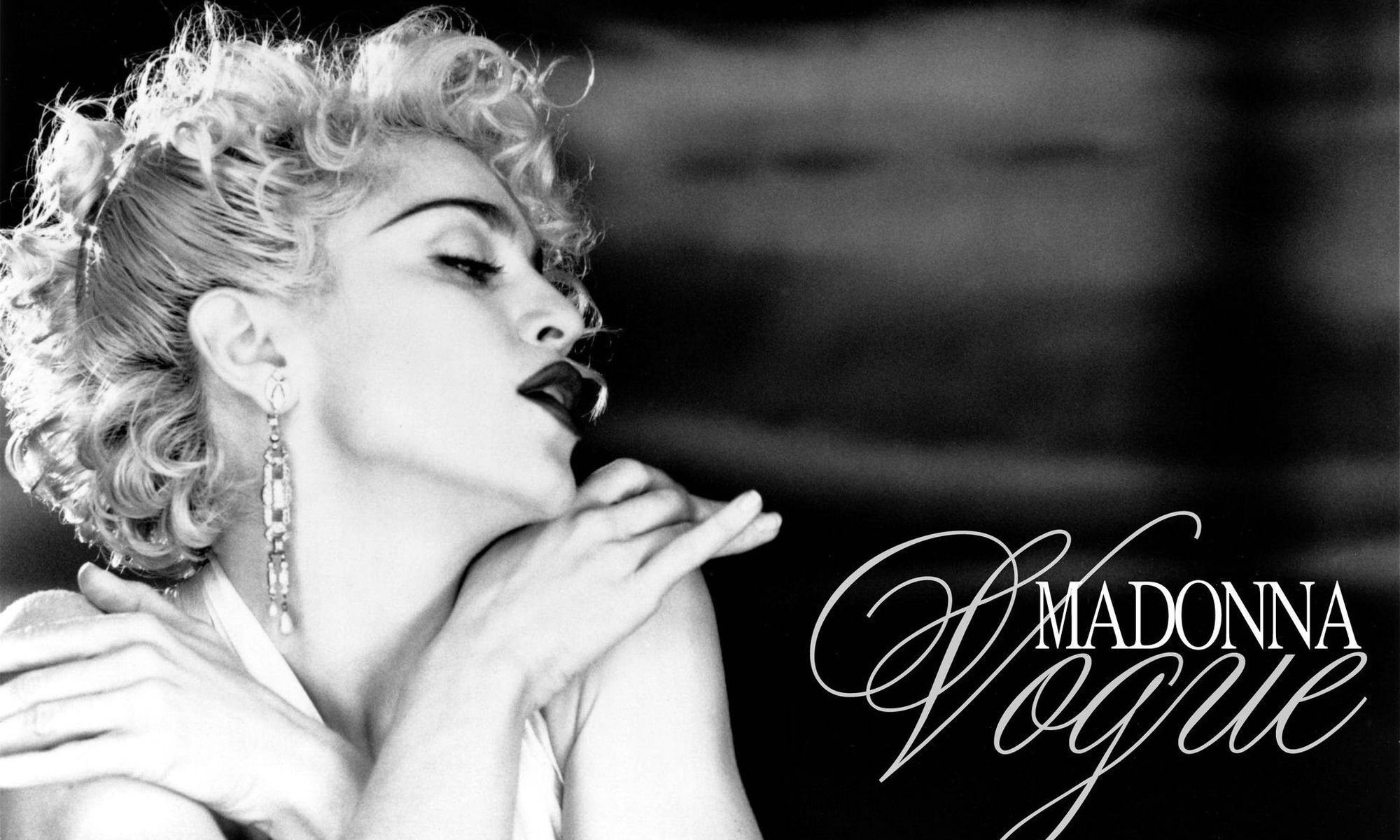
The lights inside the arena dimmed, and a roar surged through the crowd as Madonna stepped onto the stage, glittering under a cascade of white and gold beams. Beside her was her much-younger companion, hand in hand, smiling like they owned the night.
At first, the energy was electric—cheers, flashing phones, the bass thumping like a heartbeat. But then something shifted.
A lone voice cut through the noise.
“WE DON’T LIKE YOUR BOY TOY!”
Another followed.
“Henry is dead!”
Then suddenly—thwack.
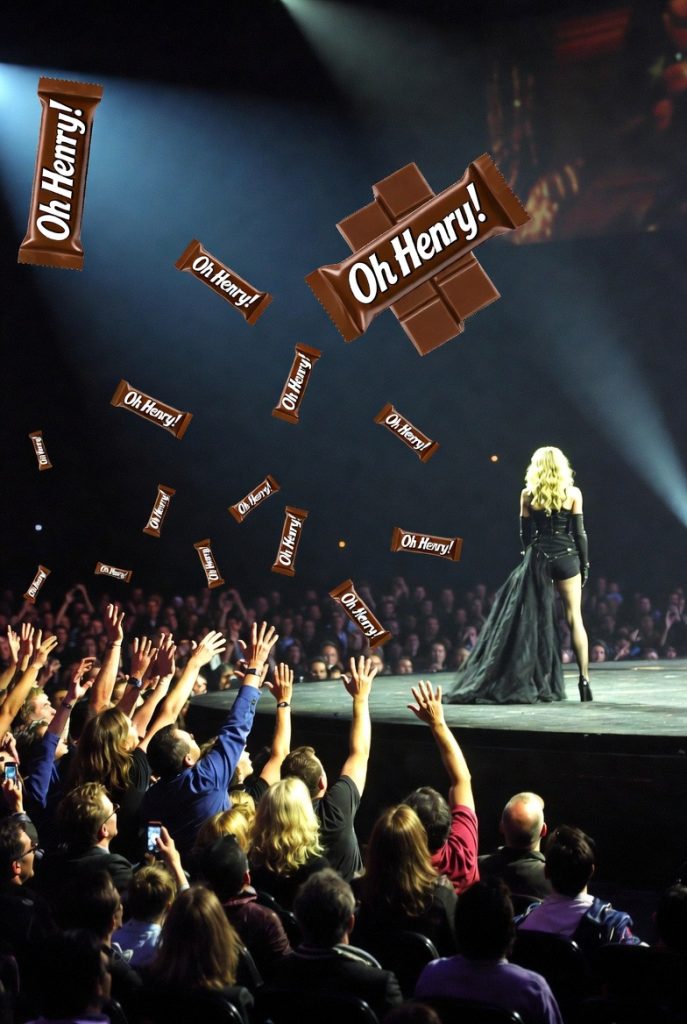
A chocolate bar flew through the air and landed near the stage. Then another. And another.
Within seconds, a rainstorm of Oh Henry! bar bars came pelting toward the stage like sugary protest missiles.
“Henry is dead! We don’t want a boy toy!” “Get over it!” “Find someone real!”
Madonna froze for a moment, stunned, as wrappers crinkled under her boots. Her dancer glanced around, unsure whether to laugh or run.
One fan near the front cupped his hands and shouted, “Marry Joe’s uncle! That’s a real man! Enough of this!”
Another yelled, “Yeah! Forget the sweet Swiss fantasy—this ain’t a ski lodge romance!”
Someone else chimed in, half-joking, half-serious: “Leave the Grand Alpina chocolate dreams behind!”
The crowd’s energy wasn’t pure anger—it was chaotic, theatrical, almost absurd. Some people were laughing, others chanting, a few still filming like it was the greatest unscripted moment they’d ever seen.
Madonna finally stepped forward, brushing chocolate off her shoulder. She raised the mic, smirking.
“You guys always did have… interesting taste,” she said coolly. “But I don’t take relationship advice from people throwing candy.”
A ripple of laughter broke the tension.
She kicked one of the chocolate bars lightly across the stage. “Besides,” she added, raising an eyebrow, “if I marry anyone’s uncle, he better dance better than all of you.”
The music kicked back in—louder this time—and slowly, the chaos melted back into spectacle. Even a few of the protesters started laughing, picking up the thrown candy like souvenirs of a bizarre, unforgettable night.
There comes a moment in every artist’s life when the mountain they thought was sacred reveals itself to be nothing more than a pile of cleverly arranged stones. In this story, that mountain is what I call Bogus Berg—a fictionalized version of those glossy, mystical “spiritual schools” that promise enlightenment but operate more like a luxury boutique for the soul. The thesis is simple: any organization that treats faith like a revenue stream is a dangerous cult—one that wants devotion only insofar as it can be monetized.
For years, the world has whispered about Madonna and her fascination with esoteric wisdom. But the truth—at least in this essay’s imaginative retelling—is not about devotion but disillusionment. The fictional Madonna of Bogus Berg didn’t walk away from her mystical mountain because she lost interest. She walked away because she finally saw the truth: her then-husband, Guy Ritchie, had already descended the mountain long before she did. In this narrative, Guy wasn’t the one clinging to the practice—he was the one slipping quietly out the back door, shaking his head at the absurdity, long before anyone noticed.
The Architecture of a “Money Mountain”
Bogus Berg’s model is simple:
Promise cosmic secrets.
Put a price tag on them.
Convince the famous that fame is a cosmic signal that they were destined to join.
Treat celebrity bank accounts like holy wells.
In this story, Madonna wasn’t recruited for spiritual depth—she was recruited because she was Madonna. Her presence added shine to the mountain. Her name added gravity. Her wallet added fuel.
Bogus Berg never asked what she believed; it asked what she could fund.
Guy Ritchie: The One Who Saw Through the Curtain
This narrative recasts Guy Ritchie not as the man who left Madonna behind, but as the man who left Bogus Berg first. Here, he plays the role of the truth-teller, the skeptic, the one who grumbled, “This is bollocks,” and walked away. In this fictionalized reimagining, his exit wasn’t a dramatic clash—it was a quiet shrug, the shrug of a man who grew tired of ceremonies that cost more than his film budgets.
But the mountain hated losing him. Bogus Berg didn’t just want followers; it wanted power couples. It wanted the image of mystical glamour. Guy’s departure cracked the facade, and when Madonna later stepped away too, the mountain lost its brightest torch.
Madonna’s Awakening
The fictional Madonna of this essay stands atop the rubble of Bogus Berg and realizes something profound: Spirituality that demands transaction is not spirituality—it’s theatre with invoices.
She discovers that real inner growth requires:
No branded water
No celebrity-only classes
No cosmic lectures that look suspiciously like sales funnels
No emotional dependence packaged as “higher learning”
Her awakening is not a rejection of mysticism, but a rejection of manipulation posing as meaning.
The Cult of Celebrity vs. the Search for Truth
Bogus Berg didn’t prey on the weak—it preyed on the powerful. The famous are often the most vulnerable because the world already believes they have everything. A person who has everything is often the one searching hardest for the one thing money can’t buy: a sense of purpose.
But Bogus Berg, in this story, turned purpose into product.
In the end, Bogus Berg is not a real place; it is a metaphor for any structure—religious, corporate, cultural—that monetizes vulnerability. The essay warns Madonna, and anyone like her, to guard their hearts, their minds, and their bank accounts from those who promise eternity but demand exclusivity, obedience, and credit card numbers in return.
Conclusion: Leaving the Mountain Behind
“Bogus Berg” is the story of a woman who climbed a mountain believing she would find enlightenment, only to discover a gift shop at the summit. It is the story of a man, Guy Ritchie, who refused the mountain’s souvenirs and walked away first. And it is ultimately the story of liberation: choosing wisdom over glamour, truth over performance, and authentic spiritual searching over curated mystical branding.
The mountain never deserved her. And when she walked away, it trembled—not because she lost anything, but because she finally saw it for what it was.
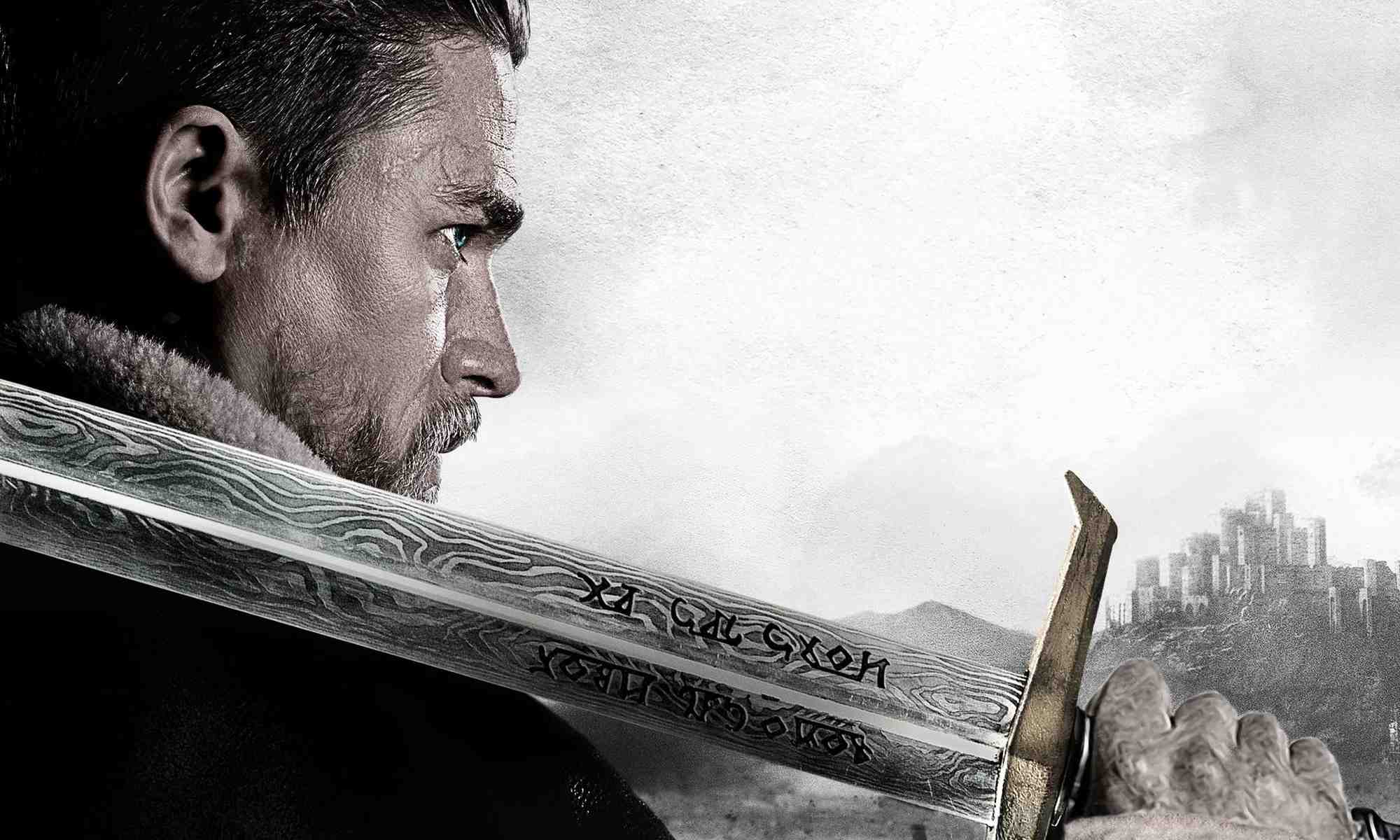
Joe Jukic and Madonna sat in the dim studio, the lights low, the bass warm and heavy. KRS-One’s voice filled the air — “The Odyssey” unfolding like a myth reborn, the Templars of Hip Hop conjuring ancient power with every bar. The moment Excalibur was mentioned, the room seemed to vibrate, as though some old, forgotten magic approved of its name being spoken again.
Joe closed his eyes and let the lyrics run through him. Hip hop as sacred geometry. Hip hop as initiation. KRS-One sounding less like a rapper and more like Merlin with a microphone.
Madonna leaned back, watching Joe take it in. She’d lived long enough, seen enough, to recognize when a force — musical, mythic, or otherwise — was speaking through the world.
When the chorus hit, she tapped Joe’s shoulder and said quietly:
“You know, Joe… with great power comes great responsibility.”
Joe smirked. “Spider-Man?”
Madonna shook her head slowly. “No. That line is older than comics. Older than Marvel. It’s a truth that goes back to every king who ever picked up a sword — especially a sword like Excalibur.”
Joe nodded, feeling the weight of her words. The song continued, KRS-One proclaiming knowledge as the true weapon, the true blade.
Madonna continued:
“Hip hop is Excalibur now. Knowledge is Excalibur. Words are Excalibur. And if you’re going to pick up a weapon like that — if you’re going to speak truth, cut through lies, and shape people’s minds — you have to treat it like a sacred duty.”
Joe breathed in. He understood. KRS-One’s voice cracked through the speakers:
“Teach the youth… guide the lost… protect the culture…”
Madonna placed a hand on Joe’s shoulder — just briefly, as if passing the sword itself.
“Use your voice like a blade,” she said. “But never forget: Excalibur chooses the one who wields it.”