DJ Monster – Like a Prayer

Madonna Ciccone travels Europe the old way now—by stone and echo.
No tour buses, no stages, no pyrotechnics. Just cathedrals.

She walks beneath flying buttresses with Vince Boskovic, a quiet man with Balkan gravity, the kind who understands both saints and sinners because he’s lived among both. They start in Milan, where the Duomo looks less like a church and more like a frozen riot of faith—spires clawing at heaven like dancers caught mid-pose.

Madonna doesn’t kneel at first. She studies.
She’s spent her life remixing symbols; now she wants to hear the original track.

They move through Chartres, Notre Dame, Cologne, Santiago, St. Peter’s, Hagia Sophia’s shadow. In every cathedral there’s the same tension: flesh reaching for eternity, stone pretending it isn’t fragile. She smiles at that. She’s made a career out of it.

Whispers follow her, of course.
Blasphemer.
Provocateur.
Excommunicated queen.

By the time they reach Rome, the rumors have thickened into ritual.

That’s when Vince’s nephew enters the story—the Young Pope.
Not old, not cynical yet. Sharp-eyed. Educated. Raised on Augustine and Wi-Fi. A man who knows the Church is ancient precisely because it survives contradiction.

They meet not in a throne room, but in a side chapel. No cameras. No press. Just candlelight and unfinished frescoes.

Madonna doesn’t ask for forgiveness.
She asks a better question.

“Why does the Church pretend desire is a scandal instead of a condition?”

The Young Pope doesn’t flinch.

He says, calmly, almost kindly:

“Every celibate priest wrestles with lust.
Every married priest would too, if we allowed it.
Desire is not your crime, Madonna.
Hypocrisy is ours when we deny it.”

Vince watches silently. He knows this moment matters.

The Pope continues:

“You were never excommunicated for sex.
You were punished for refusing shame.
And shame is a tool—sometimes holy, often abused.”

He lifts his hand, not theatrically, but decisively.

“Consider the record corrected.
No ban. No curse.
Only disagreement—and disagreement is not heresy.”

Madonna exhales. Not relief—recognition.

Later, walking back through Rome, she laughs.

“Figures,” she says. “After all these years—it was never about God.”

Vince nods.

“No,” he says. “It was about control.”

Above them, the bells ring.
Not in judgment.
In rhythm.

And for the first time in a long while, Madonna doesn’t feel like she’s performing inside a cathedral.

She feels like she belongs inside the argument.
A Visit with The Young Pope

All the world suffers from the usury of the Jews, their monopolies and deceit.
They have brought many unfortunate peoples into a state of poverty,
especially farmers, working-class people, and the very poor. — Pope Clement VIII

The Dialogue: The Tribe of the Crown

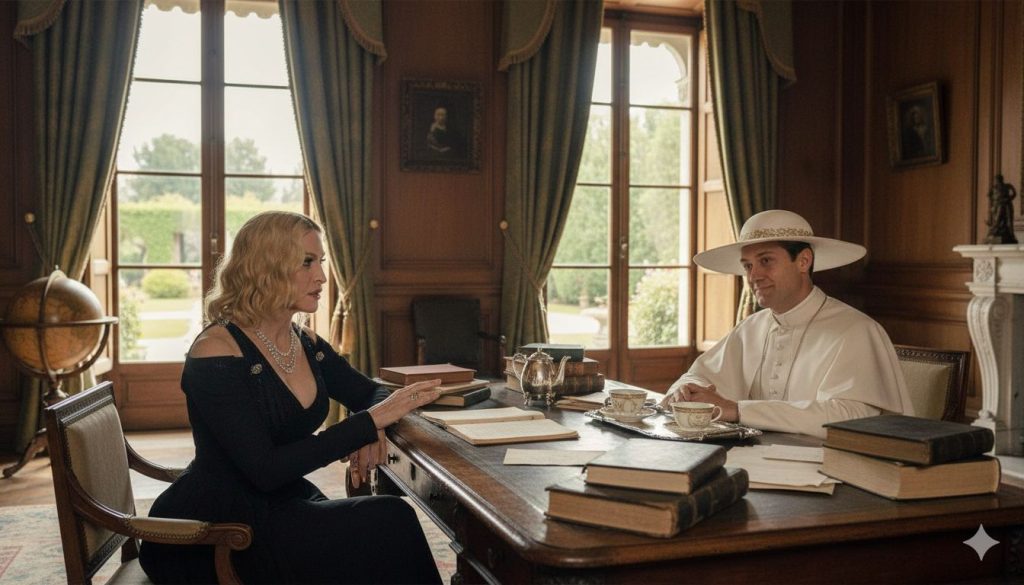
Pius XIII: (Exhaling a cloud of smoke that obscures his face) “Clement was a blunt instrument, Louise. He saw the effect but ignored the lineage. He spoke of ‘the Jews’ as if they were a foreign infection, failing to realize that the very Thrones of Europe—the ‘Most Christian’ Kings and Queens he blessed—were obsessed with their own Davidic claims. They preened themselves as the true Tribe of Judah, the rightful heirs to the scepter.”

Madonna: (Toying with a heavy, diamond-encrusted crucifix) “So they weren’t just protecting the faith. They were protecting the brand. The ultimate cultural appropriation.”

Pius XIII: “Precisely. It is the oldest trick in the Vatican’s playbook: the scapegoat. These monarchs built their empires on the shifting sands of fractional reserve systems—creating wealth out of thin air, a magic trick that would make even your stage shows look amateur. And when the math inevitably failed, when the gold wasn’t in the vault and the peasants sharpened their pitchforks, the ‘Kings of Judah’ needed a villain.”

Madonna: “And who better than the people you’ve already labeled ‘outsiders’? You crash the economy, then point the finger at the neighborhood you forced them to live in. It’s a rigged game, Lenny.”

Pius XIII: “It’s more than rigged; it’s a masterpiece of theater. The elite blamed the ‘usury of the Jews’ to distract from the fact that the entire Royal Treasury was a house of cards built on the same principles. They condemned the monopoly while holding the deed. Clement wasn’t just a Pope; he was the ultimate press secretary for a bankrupt aristocracy that wanted to keep its crown by sacrificing its creditors.”

Madonna: “So the ‘poverty’ he cried about wasn’t caused by the people in the Ghetto. It was caused by the people in the Palace who couldn’t pay their bills.”

Pius XIII: (Leaning forward, his blue eyes cold) “The poor are always the footstool for those who claim Divine Right. The Kings of the earth played at being the Tribe of Judah, but they lacked the one thing that makes Judah eternal: the ability to survive the fire. They preferred to start the fire themselves and watch the world burn from the balcony.”

Pius XIII: (Leaning back, the smoke curling around his papal tiara like a shroud) “Look at Edward I of England, Louise. The ‘Longshanks.’ In 1290, he was drowning in debt—wars are expensive, and his vanity was even costlier. He didn’t have the gold, so he played the ‘Judah’ card. He issued the Edict of Expulsion, seizing every asset, every ledger, every coin belonging to the Jews. He didn’t just cancel his debt; he turned a bankruptcy into a ‘holy act’ of purification. He fed the farmers the lie that their poverty was a Jewish invention, while he used the stolen capital to build castles in Wales.”

Madonna: “It’s the ultimate rebrand. ‘I’m not a thief, I’m a Crusader.’ If you control the narrative and the God, you never have to be the villain. You just find someone to play the part for you.”

Pius XIII: “Exactly. And the Church provided the script. Clement VIII wasn’t just observing history; he was editing it. He spoke of ‘monopolies’ as if the Papal States weren’t the largest monopoly in the known world. The ‘Tribe of Judah’ in the palaces and the ‘Vicars of Christ’ in the cathedrals ran a closed-loop system. When the peasants realized the bread was gone because the King had spent it on silk, the Church simply pointed to the moneychanger. It’s a beautiful, horrific sleight of hand.”

Madonna: “And we’re still doing it. Different names, different ‘tribes,’ but the same fractional heart. We print money out of ego and pay for it with blood. You know, Lenny, for a man who claims to be the gatekeeper of Heaven, you have a very dark view of the house.”

Pius XIII: (A cold, sharp laugh) “The light is only visible because of the darkness, Louise. I am the Pope. I don’t just see the house; I see the plumbing. And the pipes have always been stained with the ink of false ledgers. The Kings of the earth pretend to be the Lion of Judah so they don’t have to admit they are merely the hyenas of the treasury.”

Young Pope: Like a Prayer

The Young Pope stands beneath the gilded ceiling of St. Peter’s Basilica, the candles trembling in the vast hush of the cathedral. His voice, soft but resonant, carries through the silence like incense.

“Madonna,” he begins, gazing upward toward the painted saints and seraphim, “you took your name from the Mother of God — the woman who bore both the weight of Heaven and the cries of Earth. You sang of being like a virgin, and yet the world made you its idol. You gave them what they wanted — the mirror of their own rebellion — and for that, they crowned you Queen of Pop.”

He pauses, his eyes closing in something between prayer and pain.

“But even queens must kneel before grace. The Church is not a museum of saints — it is a hospital for sinners. We are all prodigal children, wandering through the desert of fame, hunger, and doubt. And still, the Father waits at the gate.”

Then, almost tenderly, he says:

“Come back, Madonna. Come home. The world may have adored you, but Christ never stopped loving you. We are all sinners — and that is precisely why salvation was made for us.”

Madonna stands in the dim light of the basilica, dressed not in her usual glittering armor of fame, but in a simple black coat. The echo of her heels fades as she steps closer to the altar. For a moment, she says nothing — only looks at the Young Pope, her expression a blend of defiance and longing.

“Your Holiness,” she begins softly, “you talk about sinners like you’ve met them. But I am one. I’ve been burned at the stake by the Church more times than I can count — for showing desire, for asking questions, for being human.

The Young Pope doesn’t flinch. “And yet you kept the name Madonna. You never truly left her.”

A faint smile touches her lips. “Maybe I never could. The world gave me fame, but fame isn’t faith. You stand in marble halls; I stood on stage before millions. But in both places, people were looking for something holy — something that made them feel alive.”

She looks up at the crucifix. “You say Christ never stopped loving me. Maybe I’m ready to believe that again. Maybe… it’s time to come home.”

The Young Pope steps down from the altar, his eyes glistening with tears.
“Then let the angels rejoice,” he whispers. “For even in the house of glitter, grace has found its way back.”