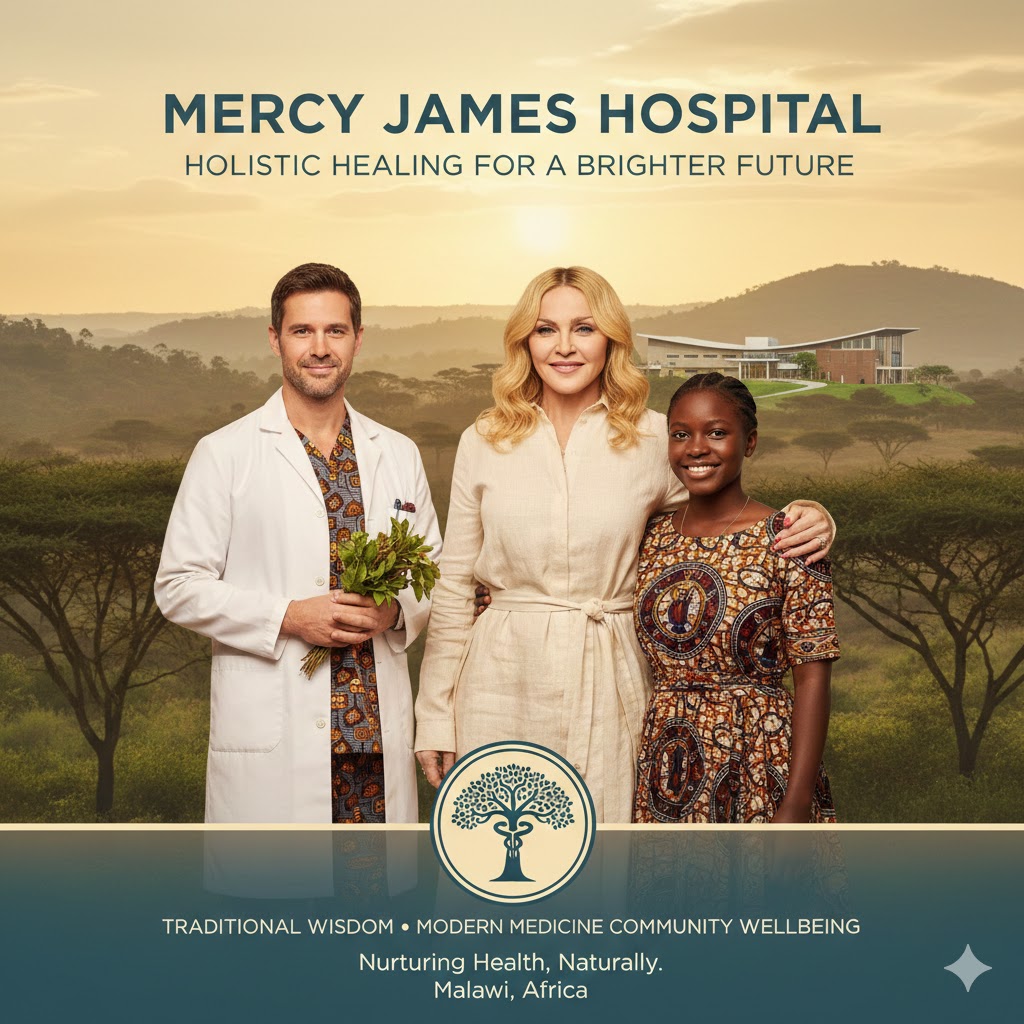
Interview Transcript: “Healing the Nations” — Dr. Luka Kovač & Nurse Erica Carmen with Madonna
Setting: The open veranda of the Mercy James Centre for Pediatric Surgery and Intensive Care in Blantyre, Malawi. The sound of distant children laughing, nurses chatting in Chichewa, and a soft breeze off Lake Malawi fills the air.
Dr. Luka Kovač: Madonna, thank you for inviting us here. When I first came to Malawi, I came as a doctor, not a prophet. But since joining your foundation’s work, I’ve seen signs — real and symbolic. When I wrote about Revelation 13, I needed something to anchor the vision of the “beast of the earth.” And somehow, you found me the Malawi lion and the leopard — two creatures that remind me that power and beauty can coexist in balance.
Madonna: I remember that. You were so moved when we visited the Liwonde National Park. The lion and the leopard are both survivors — like this country. That’s what my hospital is about: resilience. Healing the broken, protecting the vulnerable, and proving that Africa doesn’t need pity — it needs partnership.
Nurse Erica Carmen: It’s holistic care in every sense — body, mind, and community. What inspired you, Madonna, to build a hospital instead of another school or orphanage?
Madonna: Because I realized that a healthy child can learn, can dream, can build a future. But a sick child has no chance. When my daughter Mercy was born here, I promised myself I’d do something that went beyond charity. This hospital is about dignity. It’s about giving Malawian doctors like Luka the tools to heal their own people.
Dr. Kovač: And you’ve done it. When I look at Lake Malawi, I see not just a lake but a lifeline. It could feed the entire region if we manage it wisely. Imagine irrigation systems drawing from it — sustainable farming, vitamin-rich crops, real food, not imports. If the nation’s health starts with the soil, this hospital is the soul.
Nurse Erica: You’ve often said, Madonna, that “love is the new material.” Do you see that reflected here — in the work, the medicine, the children?
Madonna: Absolutely. Love is renewable energy. You can’t exhaust it. It powers every nurse who stays past their shift, every mother who carries her child for miles to reach us. You feel it in every successful surgery. It’s medicine you don’t need a prescription for.
Dr. Kovač: And when I look at the lion and leopard now, I see symbols of healing. The lion — courage. The leopard — adaptability. Together they guard this land. Perhaps they even guard us from despair.
Madonna: That’s beautiful, Luka. Maybe that’s what Revelation 13 was always trying to show us — not a prophecy of doom, but a warning to evolve. To use power, not abuse it. To heal, not to harm.
Nurse Erica: Then the beast becomes the healer — the system transformed.
Madonna: Exactly. And Malawi becomes not just a nation recovering from poverty, but a model of how compassion can rebuild the world.
Dr. Kovač: Then let this be our prayer: That the waters of Lake Malawi will feed, the lions will guard, and the children will rise — healthy, wise, and fearless.
🎙️ Interview Title: “Codex Alimentarius & The Future of Food Freedom”
Guests: Dr. Rima E. Laibow, MD Hosts: Holistic Nurse Erica Carmen & Webmaster Joseph C. Jukic
Erica Carmen (EC): Welcome everyone to Healing Without Borders. I’m Holistic Nurse Erica Carmen, and joining me as always is our brilliant webmaster and researcher, Joseph C. Jukic. Today, we’re honored to speak with Dr. Rima E. Laibow, a pioneering physician and advocate for health freedom. Our topic—one that affects everyone who eats—is the Codex Alimentarius. Welcome, Dr. Laibow.
Dr. Rima Laibow (RL): Thank you, Erica and Joseph. It’s a pleasure to be with you both and to speak about something that’s quietly reshaping global nutrition policy—often without the public’s full awareness.
Joseph C. Jukic (JJ): Dr. Laibow, many of our listeners have heard the term Codex Alimentarius, but don’t really know what it means. Can you explain it in simple terms?
RL: Certainly. Codex Alimentarius means “Food Code.” It’s a set of international food standards created jointly by the World Health Organization (WHO) and the Food and Agriculture Organization (FAO) of the United Nations. It was originally intended to ensure food safety in international trade. But over time, it has become a regulatory framework that can restrict access to vitamins, minerals, herbs, and natural remedies, under the guise of “harmonizing” laws across nations.
EC: So, in your view, Codex isn’t really about protecting consumers—it’s more about controlling them?
RL: That’s right. While the official narrative emphasizes consumer safety, the deeper reality is that Codex can be used to limit natural health options and favor pharmaceutical interests. For instance, certain Codex guidelines classify even essential nutrients as “toxins” at doses above trivial amounts. That’s scientifically absurd.
JJ: Dr. Laibow, you’ve warned that under Codex, high-potency supplements could become illegal or require a prescription. How realistic is that threat?
RL: Very realistic. In fact, the European Union already has versions of this in place—the Food Supplements Directive and the Traditional Herbal Medicinal Products Directive. Under these systems, natural substances must go through costly pharmaceutical-style approvals. Codex aims to globalize that structure. Once adopted, national sovereignty over food and nutrition policy could be lost.
EC: That’s alarming. As a nurse, I see firsthand how nutrition can heal—how vitamin D, magnesium, selenium, and omega-3s can transform lives. What happens to holistic practitioners if Codex rules become binding?
RL: It would marginalize them. Practitioners who recommend “non-approved” nutrient levels or herbal combinations could be accused of practicing outside regulated limits. It’s the medical-industrial complex consolidating control.
JJ: So it’s not just about what’s on our plates—it’s about who gets to decide what health even means.
RL: Exactly. It’s a war for definition. If the WHO defines nutrients as “toxins,” then wellness itself becomes a regulated commodity. That’s why health freedom advocates must stay alert.
EC: What can citizens do to protect their right to natural health?
RL: First, become informed. Visit the Natural Solutions Foundation website, read the Codex texts for yourself, and question politicians about their stance on health sovereignty. Secondly, support local food systems, community gardens, and farmers who resist corporate control. And finally, never surrender your right to choose what goes into your body.
JJ: That’s powerful. You’re saying health freedom is the foundation of human freedom.
RL: Absolutely. If you can’t control what goes into your body, then you don’t truly own yourself.
EC: Thank you, Dr. Rima Laibow, for your clarity and courage. We’ll keep spreading the message: education, sovereignty, and health freedom for all.
RL: Thank you both. Stay informed, stay strong, and stay well.
Interview: Joseph Jukic & Erica Carmen Talk with Dr. Joel Wallach about Brain & Mood Disorders
Participants:
Joseph C. Jukic (JJ): Webmaster, technical moderator, introduces listener questions
Erica Carmen (EC): Holistic Nurse, guiding the conversation with clinical / holistic focus
Dr. Joel Wallach (JW): Nutritional researcher / advocate
Format: Each poses questions; Dr. Wallach responds; occasional “listener” or “web question” segments.
Opening Remarks
JJ: Welcome everyone to today’s special broadcast. I’m Joseph Jukic, your host. Alongside me is Holistic Nurse Erica Carmen. Today, we have Dr. Joel Wallach, a veteran in nutritional medicine, joining us to examine some of the most daunting brain and mood disorders: dementias, Alzheimer’s, bipolar disorder, depression, and anxiety. Thank you for being here, Dr. Wallach.
JW: Thank you, Joseph, Erica. I’m grateful for the opportunity to discuss these critically important topics.
EC: Yes, Dr. Wallach—these are conditions that affect millions and challenge conventional medicine. Let’s dive in gently but deeply.
1. Framing the Problem: Why are these disorders increasing?
EC: Dr. Wallach, from your vantage point, we see rising rates of Alzheimer’s, dementia, depression, anxiety, and mood disorders. What is your foundational explanation for that trend?
JW: I see a convergence of factors. The modern age has stripped away many of the elemental supports that human biology requires: depleted soils, processed foods, chemical exposures, chronic stress, lack of essential minerals and micronutrients. Over decades, the brain, which is highly metabolically demanding and exquisitely sensitive, experiences incremental deficits and damage.
Whereas in the past, the margin of safety was wide, now many people live on the “edge” — one further insult pushes the system over. So Alzheimer’s and dementia are, in my view, advanced forms of nutrient-deprivation plus toxicity, while mood disorders reflect earlier, more subtle dysfunctions of neurotransmitter synthesis, antioxidant systems, methylation, and cellular energetics.
2. Alzheimer’s & Dementia: What is really happening?
JJ: Let’s talk about Alzheimer’s and other dementias first. The mainstream model emphasizes beta-amyloid plaques, tau tangles, neuroinflammation. From your perspective, what is the “root cause,” and how would a nutritional approach differ or supplement standard care?
JW: The mainstream markers (amyloid, tau) are downstream phenomena—symptoms, not causes. The brain, when under chronic oxidative stress, inflammation, and deprived of repair components, begins to misfold proteins, accumulate waste, and lose neuronal integrity.
Here’s how I frame it:
Nutrient deficiency: Key trace minerals, vitamins (especially B vitamins, antioxidants, magnesium, selenium, zinc, copper balance, etc.) are chronically low in many patients. Without them, enzymes fail, repair slows, DNA damage accrues.
Toxic burden: Heavy metals, environmental pollutants, pesticides, plasticizers, electromagnetic stress—these impose damage and interfere with cellular machinery.
Energy & mitochondrial dysfunction: Neurons are energy hogs. If mitochondria falter because of missing co-factors, the neuron becomes vulnerable.
Poor waste clearance: The brain’s “garbage disposal” systems (glymphatic, microglia, proteolytic enzymes) need support. If they lag, misfolded proteins, plaques, and debris accumulate.
So the therapeutic approach is to nourish, detox, support energy, and restore repair systems, not just block or clear plaques.
EC: In practical terms, what kind of supplementation or intervention protocol would you use for an Alzheimer’s patient or someone in early dementia?
JW: Here is a general “nutritional neurology” protocol (tailored per patient):
Comprehensive assessment
Micronutrient panels, heavy metal/toxin screen, methylation markers, oxidative stress markers
Cognitive testing, imaging, gut / microbiome evaluation
Core supplementation
Full-spectrum multivitamin / multimineral that includes rare trace minerals
High-dose antioxidants (vitamin C, E, glutathione, NAC, coenzyme Q10)
Methylation support (methyl-B12, methyl-folate, B6)
Choline, phosphatidylcholine, inositol (for membrane and neurotransmitter support)
Omega-3 fatty acids (EPA / DHA) for neuronal membranes
Magnesium (preferably magnesium threonate for CNS penetration)
Minerals like selenium, zinc, copper (balanced), manganese
Over months to years, you aim to stabilize, slow progression, and ideally regain some function where possible.
3. Mood Disorders: Bipolar, Depression, Anxiety
JJ: Let’s shift to bipolar disorder, depression, and anxiety. Conventional psychiatry treats them with psychotropic drugs (antidepressants, mood stabilizers, antipsychotics). In your framework, how do these conditions arise, and how might nutrition remediate them?
JW: I view mood disorders as metabolic / biochemical disorders of the brain first, not merely “mental illness” in isolation. Many of the same factors apply:
Be cautious with stimulant precursors. Mood swings or mania may worsen if neurotransmitter precursors are too aggressive.
Stabilizing agents (nutritional & herbal) like inositol, lithium (nutritional levels), magnesium, omega-3 high EPA may help.
Monitor electrolyte balance continuously—imbalances can shift mood.
Monitoring by a clinician is critical, especially if patients are already on psychotropic medications.
Adjust doses slowly; watch for mood switches.
Emphasis on stabilization, rather than pushing peaks.
4. Listener / Web Questions
JJ: We have several listener-submitted questions. Let me read a few:
Caller A:“My mother has moderate Alzheimer’s. Will nutritional therapy reverse her memory loss?”
JW: It depends on how much neuronal loss or brain atrophy has occurred. In earlier stages, yes: memory, cognition, recognition, even structural improvements are possible. In later stages, full reversal may be unlikely, but stabilization, slowing decline, reducing symptoms, and improving quality of life is very achievable. Nutritional healing is not magic but helps the body express its latent repair potential.
Caller B:“I was diagnosed with bipolar II years ago and have taken medications. Can I wean off and try nutrition instead?”
JW: Very carefully, under medical supervision. Don’t abruptly stop medications. First, support nutritional groundwork (minerals, methylation, antioxidant support) while gradually tapering medications under psychiatric supervision. Watch for mood destabilization. Some patients may reduce doses; others may need medication long term, but nutritional support always helps reduce side effects and protect brain health.
Caller C:“Is depression just low serotonin? Why do drugs sometimes help, but often don’t fully resolve symptoms?”
JW: Depression is far more complex than “low serotonin.” It’s a network failure: receptor sensitivity, neurotransmitter synthesis, neuroinflammation, energy deficits, methylation dysregulation, gene expression, and neural pruning all play roles. Drugs that boost serotonin temporarily shift chemistry—but if underlying nutrition, inflammation, mitochondrial health, and repair systems are neglected, the benefit is partial and often temporary.
5. Integration, Risks, and Skepticism
EC: Critics will say that much of what you propose lacks large-scale randomized clinical trials. How do you respond, and what are the risks / limitations?
JW: I am aware of the critique. My response:
Nutritional interventions cannot be patented, so there is less commercial incentive to fund large trials.
Traditional trials isolate single agents, whereas real-world healing is multi-factorial. Nutrient synergy is essential and harder to test in single-variable models.
There are case studies, observational data, patient-reported outcomes; these deserve more weight.
I’m not against trials—I urge integrated, systems-based trials.
As for risks:
Overdosing certain nutrients (e.g. fat-soluble vitamins, trace minerals) can be harmful.
Interactions with medications need monitoring.
Mood disorders particularly risk swings when changing neurochemical environment.
Any detox protocol must be gentle and monitored to avoid “detox reactions.”
Not every patient will respond; expectations must be realistic.
Proper clinical oversight is mandatory.
6. Final Thoughts & Hope
JJ: As a closing, Dr. Wallach, what is your message of hope for people suffering or caring for loved ones with Alzheimer’s, bipolar, depression, anxiety?
JW: My core message: Your body is faithful, if given the chance. These conditions are not curses—they are calls for correction and care. No, I don’t guarantee full cures in every case. But I’ve seen people regain clarity, mood stability, memory, quality of life. The road is not easy, it demands consistency, patience, humility, and a holistic vision. But healing is possible, at multiple levels—biochemical, emotional, spiritual.
EC: That is beautiful. Thank you, Dr. Wallach, for your insights and for pushing the boundary of what is medically accepted.